
Shopify Migration. Benefits, Growth Opportunities & What Businesses Should Know
Migrating to Shopify improve ecommerce performance, simplify store management, and support long-term business growth. Explore the benefits of Magento, WooCommerce, and other platform migrations.
On this page6 sections
- Why Are Businesses Migrating to Shopify?
- What Growth Can You Expect After Migrating to Shopify?
- 7 Key Benefits of Migrating to Shopify
- Magento to Shopify Migration: Why Are Businesses Making the Switch?
- WooCommerce, Squarespace, Wix and Other Platform Migrations
- Why Choose Agentix Marketing for Shopify Migration?
Why are businesses migrating to Shopify?
Migrating to Shopify help businesses improve ecommerce performance, simplify store management, enhance customer experience, and build a scalable online store while protecting existing SEO value through proper migration planning and implementation.
"Your ecommerce platform should help your business grow, not hold it back."
Running an online store involves more than selling products. You need a website that loads quickly, provides a smooth shopping experience, supports your daily operations, and can handle your business as it grows.
But what happens when your existing ecommerce platform starts doing the opposite?
Slow performance, complicated maintenance, limited customization, expensive integrations, and technical issues can make it increasingly difficult to scale. For many businesses, this is the point where migrating to Shopify becomes worth considering.
Whether you're running WooCommerce, Magento, BigCommerce, Wix, or a custom-built ecommerce website, moving to Shopify can provide a more manageable and scalable foundation for your online business.
But is the migration worth the investment? What improvements can you expect, and how do you improve your sales and customer data during the transition?
Let's take a closer look.
Why Are Businesses Migrating to Shopify?
As ecommerce competition increases, customer expectations continue to change. Shoppers want fast websites, easy navigation, mobile-friendly product pages, convenient payment options, and a checkout process that doesn't create unnecessary friction.
Unfortunately, some older or heavily customized ecommerce platforms can become difficult to maintain as businesses expand.
For example, a WooCommerce store may depend on multiple plugins for essential functionality, while a Magento website may require ongoing technical support for routine updates. Custom-built platforms can also become expensive when new features or integrations are needed.
Shopify offers an alternative through its hosted ecommerce platform, centralized store management, extensive app ecosystem, and flexible development capabilities.
Some of the biggest reasons businesses consider Shopify migration include:
- Simpler management: Manage products, orders, inventory, and customers from one dashboard.
- Scalability: Support larger product catalogs and growing order volumes.
- Customization: Build storefronts around your brand and customer experience.
- Integrations: Connect marketing, payment, shipping, inventory, and business management tools.
- Mobile shopping: Create responsive experiences across different devices.
- Reduced maintenance: Spend less time managing infrastructure and more time growing your business.
The objective isn't simply to move your website to another platform. It's to create an ecommerce environment that makes running and expanding your business easier.
What Growth Can You Expect After Migrating to Shopify?
One of the biggest questions business owners have is whether changing ecommerce platforms can actually improve business performance.
Migration alone doesn't guarantee higher sales or conversions. However, when combined with better design, performance optimization, SEO, and conversion-focused development, it can create opportunities for measurable growth.
Agentix Marketing reports the following typical results across its migration and ecommerce engagements:
- 65% average conversion rate lift through improved shopping experiences.
- 145% higher mobile conversion through mobile-focused optimization.
- 40% faster page loads through performance improvements.
- 500+ Shopify migrations completed across different ecommerce platforms.
A practical example is Thinkware, which migrated from WooCommerce to Shopify in six weeks. According to Agentix's published case study, the migration covered 3,200 product pages and more than 12,000 redirects, while preserving its organic search rankings.
These results highlight why migration should be approached as a complete ecommerce project rather than a simple data transfer.
Every business starts from a different position, so actual results depend on the existing website, migration scope, and optimization strategy.
7 Key Benefits of Migrating to Shopify
1. Better Flexibility and Customization
Your ecommerce platform should adapt to your business requirements.
Shopify allows businesses to customize homepage layouts, product pages, collections, navigation, promotional sections, and other storefront elements.
With themes, apps, APIs, and custom development, you can create a shopping experience that reflects your brand instead of relying entirely on a standard template.
2. Easier Store Management
Managing an ecommerce business involves products, orders, customers, inventory, promotions, refunds, and fulfillment.
Shopify brings many of these activities into one centralized dashboard, making everyday store management more straightforward for business owners and their teams.
3. More Integration Opportunities
Modern ecommerce businesses rely on multiple tools to operate efficiently.
Shopify supports integrations with platforms such as Klaviyo, accounting software, shipping providers, inventory systems, customer support tools, and analytics applications.
These connections help create a more organized workflow and reduce unnecessary manual work.
4. Improved Mobile Shopping Experience
Mobile customers expect websites to work smoothly on smaller screens.
A properly developed Shopify store can provide responsive layouts, simplified navigation, optimized product pages, and convenient checkout experiences.
This is particularly important for businesses that receive a significant portion of their traffic from mobile devices.
5. A Stronger Foundation for Shopify SEO
One of the biggest concerns during ecommerce migration is losing existing Google rankings.
Your current website may already have valuable organic traffic, backlinks, indexed pages, and established search visibility. A poorly managed migration can put these assets at risk.
A properly planned Shopify SEO migration should include:
- Existing URL and keyword ranking documentation.
- Relevant 301 redirect mapping.
- Preservation of important content and metadata.
- Heading structure and image alt text checks.
- Internal linking review.
- Canonical and sitemap verification.
- Google Search Console monitoring after launch.
Shopify doesn't automatically improve your rankings. The goal is to preserve your existing SEO value while building a technically sound foundation for future growth.
6. Opportunities for International Expansion
If your business plans to reach customers in different countries, Shopify offers tools for international selling, including multiple currencies, localized shopping experiences, and market-specific configurations.
This gives growing brands more flexibility when expanding into new markets.
7. More Time to Focus on Business Growth
A manageable ecommerce platform means less time dealing with technical maintenance and more time focusing on marketing, customer acquisition, product development, and retention.
Your technology should support your business strategy rather than constantly getting in its way.
Magento to Shopify Migration: Why Are Businesses Making the Switch?
Magento is a powerful ecommerce platform, particularly for businesses with complex customization requirements. However, maintaining a Magento store can involve significant technical resources, development costs, and infrastructure management.
For businesses looking for a different approach, Magento to Shopify migration can offer several advantages.
Shopify provides hosted infrastructure, centralized management, an extensive app ecosystem, and flexible storefront development.
Businesses can also consider Shopify Plus when they require more advanced enterprise ecommerce capabilities.
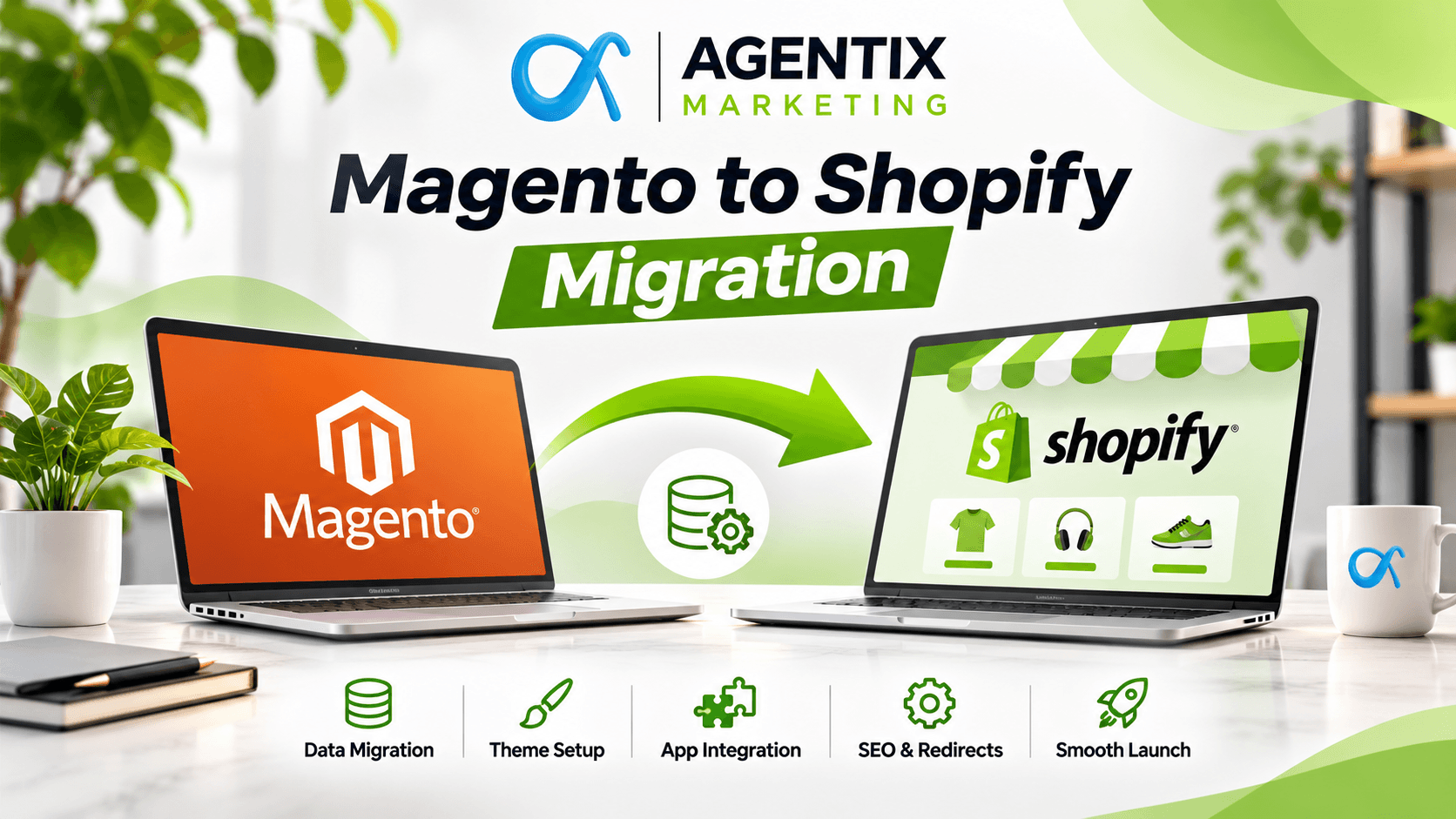
A Magento migration typically involves transferring:
- Products, categories, and product variants.
- Customer accounts and historical orders.
- Product images and important content.
- Existing URLs and SEO metadata.
- Custom functionality and integrations.
- Payment and shipping configurations.
The important part is understanding which existing features need to be retained, improved, or replaced before the migration begins.
WooCommerce, Squarespace, Wix and Other Platform Migrations
Magento isn't the only platform businesses move away from.
WooCommerce to Shopify migration: Suitable for businesses looking to simplify WordPress-based ecommerce management and reduce dependence on multiple plugins.
Squarespace to Shopify migration: Worth considering for brands moving from a content-focused website toward a more comprehensive ecommerce operation.
Wix to Shopify migration: A potential option for businesses expanding their product catalogs and requiring more ecommerce-focused functionality.
BigCommerce to Shopify migration: An option for businesses whose requirements around customization, integrations, or store management make Shopify a better fit.
Custom platform to Shopify migration: Can help businesses reduce infrastructure complexity while retaining essential functionality through integrations and custom development.
The right platform depends on your business model, technical requirements, and long-term goals.
Why Choose Agentix Marketing for Shopify Migration?
Migrating an ecommerce website requires more than transferring data between platforms. You need a team that understands Shopify development, SEO, integrations, and conversion optimization.
At Agentix Marketing, we approach platform migration with a focus on protecting what already works while creating opportunities for future growth.
Our Shopify migration services include:
- Migration planning: Reviewing your existing platform, website structure, and business requirements.
- Complete data migration: Transferring products, variants, customers, orders, and relevant content.
- Shopify store development: Building a customized, responsive storefront around your brand.
- SEO preservation: Documenting existing rankings, mapping URLs, and implementing 301 redirects.
- Integration support: Reconnecting payment systems, shipping tools, ERP platforms, and marketing applications.
- Post-launch monitoring: Monitoring organic rankings, crawl health, and website performance after migration.
With 500+ Shopify migrations completed, our team has experience working with WooCommerce, Magento, BigCommerce, Squarespace, Wix, and custom-built platforms.
Our typical migration build timeframe is 4–10 weeks, depending on store size, data complexity, integrations, and redesign requirements.
Ready to move your ecommerce business to Shopify?
Don't let an outdated platform limit your next stage of growth.
Explore Agentix Marketing's Shopify Migration Services (opens in a new tab) or contact our team (opens in a new tab) to discuss your existing store and get a migration strategy tailored to your business.
The cost depends on your existing platform, store size, product catalog, custom functionality, and integration requirements. A migration assessment helps determine the scope and estimated investment.
Simple migrations may take a few weeks, while larger projects can require several months. Agentix Marketing's typical migration timeframe is 4–10 weeks, depending on project complexity.
Yes. Products, images, variants, customer records, historical orders, and other relevant data can generally be migrated. The exact process depends on your existing platform and data structure.
Yes. Agentix Marketing provides migration planning, data transfer, Shopify store development, SEO preservation, redirect implementation, integration support, testing, and post-launch monitoring. Ready to make the move? Talk to Agentix Marketing about your Shopify migration project.